
The Project
This research project explores the ordinary labor that sustains extraordinary innovation. Through photography, I look beyond finished products or famous companies to the people who support every stage of production, distribution, maintenance, and care. Each photograph captures a small but crucial moment in a much larger network of making.

Huaqiangbei
Often referred to as "China's Silicon Valley," Huaqiangbei is celebrated as a place of rapid innovation, entrepreneurial ambition, and the epicenter of the "maker" movement. Yet beyond the storefronts filled with electronics lies another story—one told through delivery riders weaving through traffic, workers hauling boxes by hand, repair technicians soldering circuit boards, and shopkeepers whose everyday labor keeps the district alive.
I traveled to Huaqiangbei to document these overlooked forms of work and to better understand the human infrastructure behind technology.
The "maker" movement sought to blur this false distinction. By lowering the barrier of entry to bringing ideas to life, more individuals are empowered to create. As Chris Anderson claims, “Transformative change happens when industries democratize, when they’re ripped from the sole domain of companies, governments, and other institutions and handed over to regular folks” [Anderson, Makers, 63↗]. The maker movement makes this democratization possible by making resources required for creating more accessible than ever—it gives everyone the chance to make things instead of simply consuming. Additionally, open-source innovation and tech entrepreneurship opportunities, especially in Shenzhen, have built an “ecosystem” of “deep trust” among engineers, manufacturers, and businesses fosters collaboration that allows for bottom-up innovation [Koney, Making Africa in Shenzhen]. You no longer need to sell your idea to a large company that can fund the manufacturing of the product; you can now build it yourself for a fraction of the cost.
Nevertheless, the "maker" movement still excludes many through structural barriers of cost, education, and access to specific tools. Like how the Information Revolution “was not the creation of the computer, but rather the democratization of the computer,” the true maker movement doesn’t happen until resources, and the education for using those resources, are accessible [Anderson, Maker, 13:30↗]. And while the open-source nature of the maker movement has created a global network of individual makers, it continues to overlook the labor done by factory workers, caregivers, and everyone who sustain “innovation” but are not acknowledged as “makers” [Chachra, Why I am Not a Maker↗].
So I return to the question: what makes some forms of labor more valuable—and some people more deserving of being called “makers”—than others?
As you explore the images, I invite you to look beyond what is immediately visible. Consider not only the technologies on display, but also the people whose work allows those technologies to exist.
A Community, Not Just a Marketplace
Huaqiangbei, specifically the SEG Electronics Market, felt less like a collection of individual shops and more like a community. Vendors chatted with one another across stalls. A vendor walked through the market selling Yakult, a popular beverage, while snack shops—both inside and outside the building—offered workers a place to grab a quick pause between tasks.


A Familial Affair
Business and family life seemed deeply intertwined. Young children played video games behind counters or finished homework while parents worked. As they grew older, many became part of the daily rhythm—boxing products, organizing inventory, or assisting with simple repairs.


The Role of Women
Across many stalls, women appeared to outnumber men. They managed storefronts, assembled electronics, handled customer interactions, and coordinated daily operations. Their presence challenged my assumptions about who performs the everyday work that sustains the hardware ecosystem.


Tea & Smoke
The scent of tea and cigarette smoke drifted through the aisles. Between sales, vendors gathered around small tables, sharing tea and conversation. Business appeared to be built on the trust, familiarity, and time spent together that those products bring.


The Sound of Packing
The sharp rip of packing tape echoed from stall to stall, becoming the soundtrack of constant movement as products were boxed, sealed, and sent on their way.


The Work Behind the Work
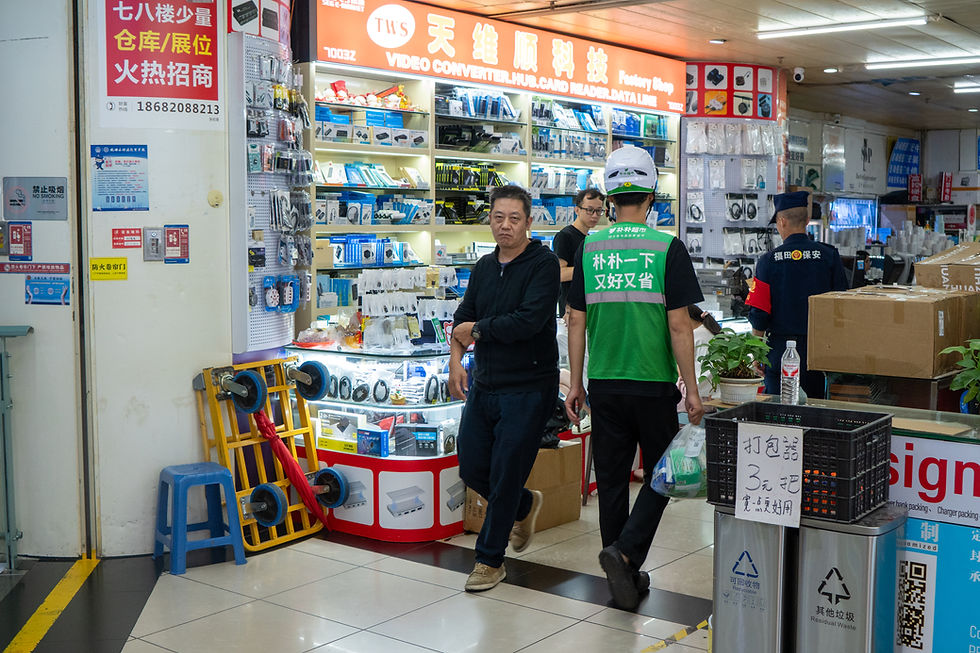
Even beyond the vendors is a network of even more unseen labor—security guards, cleaners, food delivery drivers, handcart operators, and landscapers. Their work fades into the background, yet they're the ones who maintain the safety, cleanliness, and daily operations that allow thousands of daily transactions to take place.



Rethinking "Making"
Going to Huaqiangbei and seeing these moments challenged my understanding of what it means to be a "maker." These seemingly ordinary moments—the sound of packing tape, children running around the marketplace, vendors sharing tea, cleaners sweeping—formulate an alternative picture to what we conventionally understand as "innovation."
So, what does it even mean to “make”? Is “making” the ideation of a product? Is it the process of resourcing? Is it the physical manufacturing of it? Or is it all of them combined? Perhaps, “making” is “ordinary labor” [Stevens, Quotidian Labour↗]. What we conventionally understand as "making" does not happen without the labor of caretakers, factory workers, and unseen workers who enable production, distribution, and repair. And so, designing, manufacturing, and maintenance are not as separate as they seem, as they are all equally central to technological life [Jackson, Rethinking Repair↗]. The value is co-created, and so the real value of “making” comes from the networks of labor, institutions, and social practices.
The Question
For years, I thought being a maker meant designing and building objects. But every project left me wondering: Who built my printer? Who assembled its components? Who transported the filament? These questions led me to ask who gets to be considered a “maker.”
Historically, Western notions of "making" have privileged powerful, often upper-class men whose ideas are brought to life through the labor of others. This creates a distinction between high-value design and low-value manufacturing, shaped by economic, geographic, and gendered privilege [Stevens, Quotidian Labor↗]. A product marked “Made in China” is often perceived as cheap, while “Designed in California” signals something premium.
